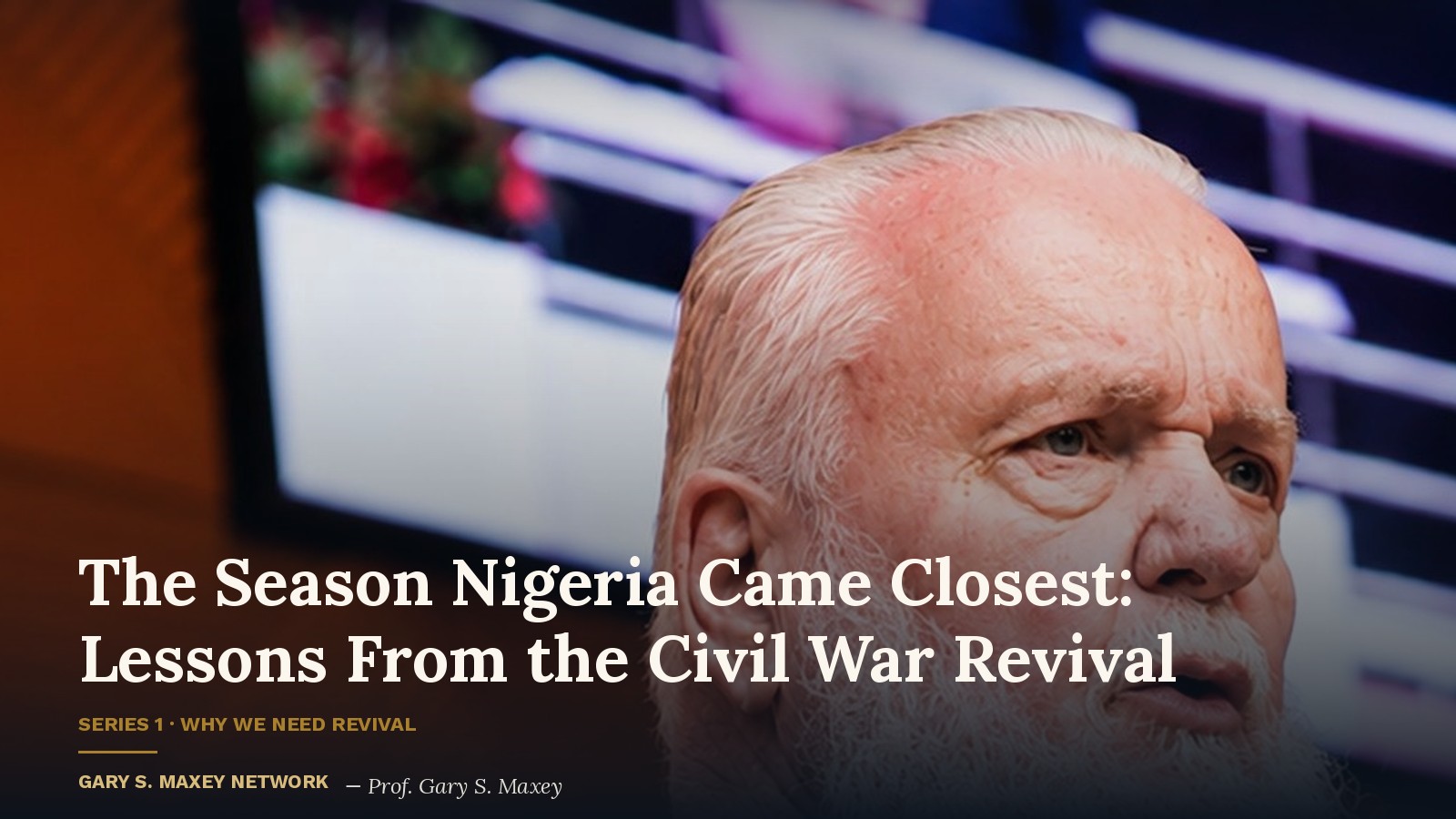
The Season Nigeria Came Closest: Lessons From the Civil War Revival
Drawn from the teaching of Professor Gary S. Maxey · 3 min read
Professor Gary Maxey calls the Civil War Revival the greatest revival Nigeria has witnessed. It lasted about a decade, from the mid-1960s into the mid-1970s. It started in the west, spread east and north, and faded by the middle of the 1970s. Along the way hundreds of thousands came to the Lord in deep repentance, hundreds of new churches were established, and the church growth that has marked Nigeria ever since received its first push.
He considers it the closest Nigeria has come to a national spiritual awakening.
Where it began
The revival began among university students in the west. Many had been shaped during secondary school by the Scripture Union. In the east, during the thirty months of the civil war from 1967 to January 1970, revival fires were stoked in Scripture Union camps where young people gathered as refugees.
The setting is worth noticing. Young people with nothing, displaced by war and facing real danger, were hungry for God. The revival grew in a time of deep need.
What it looked like early on
In its early years the revival featured fervent evangelistic preaching. Whole villages were evangelized. Communities in the west and east received the message, and it reached the Middle Belt and the North.
Professor Maxey adds that the driving impulse was to be like Jesus and to serve him through the Holy Spirit. People understood that carnal anger, petty jealousy, lust, materialism and pride were not signs of a Spirit-filled life. The moral and ethical meaning of being filled with the Spirit was clear.
How it faded
He names several causes, and they are worth studying.
1. A shift in focus. What began as an evangelical awakening turned by 1969 and the early 1970s into a largely Pentecostal movement. When attention moved from Christlike character to outward signs and gifts, the revival spirit weakened. 2. A rush of new churches. Many young leaders, encouraged by respected elders such as the British missionary Sydney Elton, left mission-founded churches to plant independent ones. Elton did not intend rivalry, but rivalry, lack of training and lack of accountability followed. 3. The sidelining of the older churches. The Anglican, Presbyterian, Methodist and Baptist churches, and others, largely sat out the revival. They were stirred to growth only in the 1980s.
He considers this the revival's major failure: it had minimal impact on many mainline churches.
What the Nigerian church can learn
The first lesson concerns discipline. Revival energy needs structure to survive. Fresh believers need teaching, and new churches need accountability. Without them the fire spreads and then dies.
The second lesson concerns unity. Revival that stays inside one stream of the church leaves the others untouched. Professor Maxey notes the contrast with East Africa, where the revival unfolded within the Anglican Church, the largest church in the region, and went deep and lasted long.
The third lesson concerns focus. When the church shifted from character to charisma, it lost something it has not recovered. The call for holy living was the heart of the early revival.
A closing thought
Professor Maxey himself took part in a later season of prayer in Port Harcourt in 1983 and 1984, when believers prayed together for more than three months. He speaks of mighty revival blessings as a result.
Many people alive today remember the Civil War Revival. If you are one, write down what you saw. The next generation needs the account.
Drawn from the teaching of Professor Gary S. Maxey.