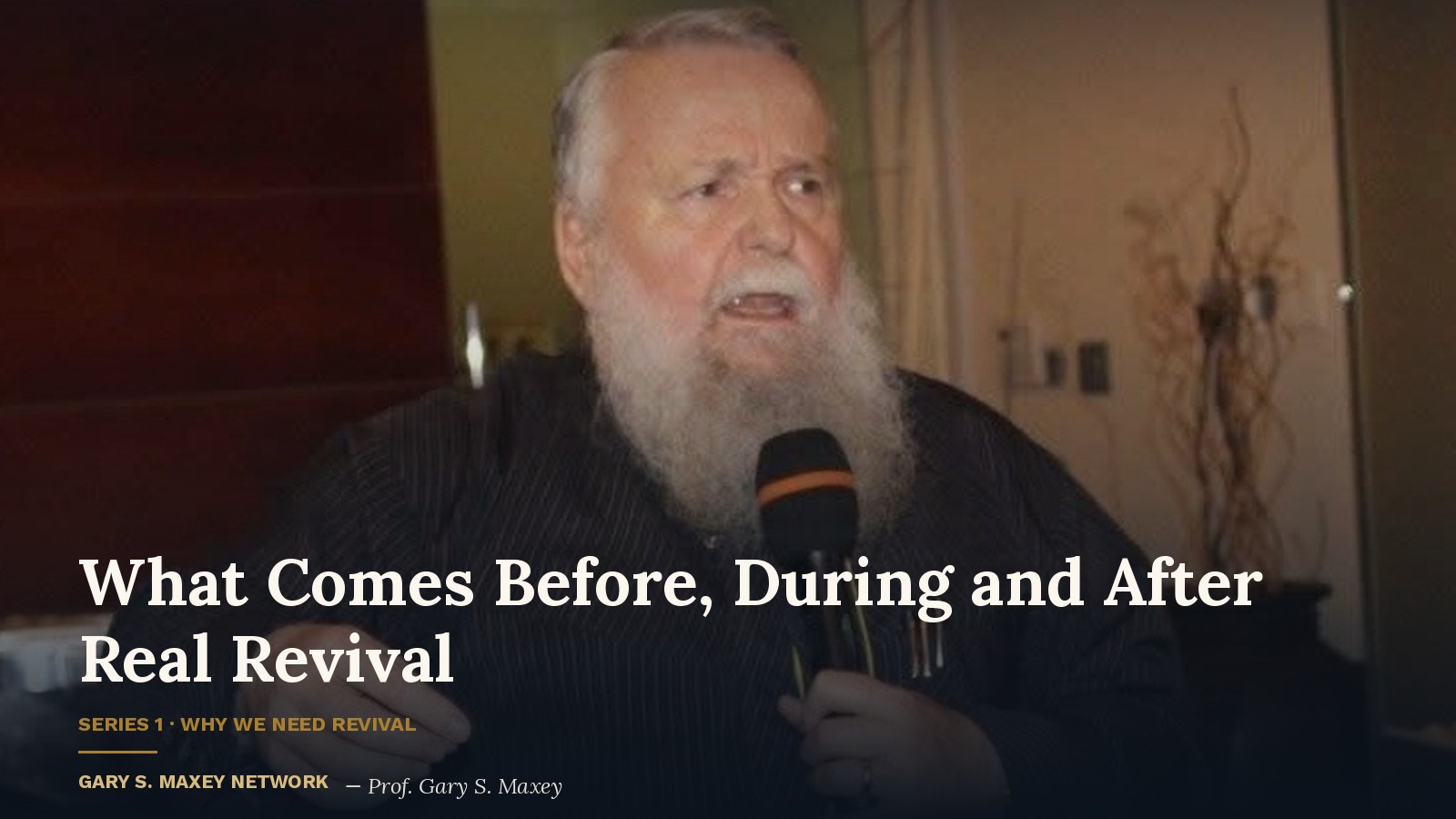
What Comes Before, During and After Real Revival
Drawn from the teaching of Professor Gary S. Maxey · 3 min read
Many churches use the word revival without agreeing on its meaning. Professor Gary Maxey gives the church a tool for testing the claim. He offers a definition of revival in which every phrase carries weight, and he asks us to read it slowly.
Biblical revival, he writes, is a spontaneous spiritual awakening by the Holy Spirit among professing Christians. It is preceded by a deepening sense of spiritual need and conviction for sin and by earnest prayer. It results in repentance, restitution, reconciliation, a deepened spiritual experience, holy living, evangelism and missions.
Read that sentence as a timeline and it falls into three parts.
What comes before
Three things arrive first: a deepening sense of spiritual need, conviction for sin, and earnest prayer. These are the soil. Nobody schedules them, and nobody buys them. They show up when believers stop congratulating themselves and start looking honestly at their lives.
Professor Maxey says this stage is easy to skip and impossible to fake. A church that jumps straight to celebration has missed the first requirement. A church that prays only for blessing, protection and breakthrough has missed the second. In his words, all genuine revivals begin with a great sense of spiritual need, and God does not pour revival on people who think they are doing great.
What accompanies it
When the Spirit moves, three marks appear in public: repentance, restitution and reconciliation.
Repentance is a change of direction, and the Bible links it to tears more often than to applause. Restitution is putting right what can be put right, whether a debt, a theft or a lie. Reconciliation is the healing of broken relationships between neighbors, between families, and between believers who have been enemies.
These three marks make revival visible. A visitor to a town in revival does not need to see a crowd to know something has happened. He sees men paying what they owe and people shaking hands who have not spoken for years.
What follows
Four things come after: a deepened spiritual experience, holy living, evangelism and missions.
The order matters. Many churches begin with evangelism and missions and hope holiness will catch up. Professor Maxey observes that genuine revival works the other way. Believers are first cleansed and deepened. Then they go out. The East African revivals produced evangelists who walked across borders. The Congo awakening of 1953, marked by weeping and a strong focus on holiness, gave fresh power to the churches.
It is God's work
One word in the definition is easy to miss. Revival is spontaneous. Professor Maxey explains that it is not a man-made affair. It is a sovereign move of God, which is why it must be preceded by much prayer.
We cannot produce a revival by planning a program. We can pray, repent and remove what stands in the way. The rest belongs to God.
Using the definition
Measure your own church with these questions.
1. Is there a growing sense of need among the people, or a growing sense of comfort? 2. Are people confessing sin to one another and to God? 3. Has anyone returned something, paid something back or asked forgiveness? 4. Are believers living differently at home and at work? 5. Is the church sending out people who carry the gospel to others?
If the honest answers are mostly no, the church is not yet in revival. That is not a reason for despair. It is a map. Start at the beginning of the timeline, and ask God to give your church a sense of need.
Drawn from the teaching of Professor Gary S. Maxey.