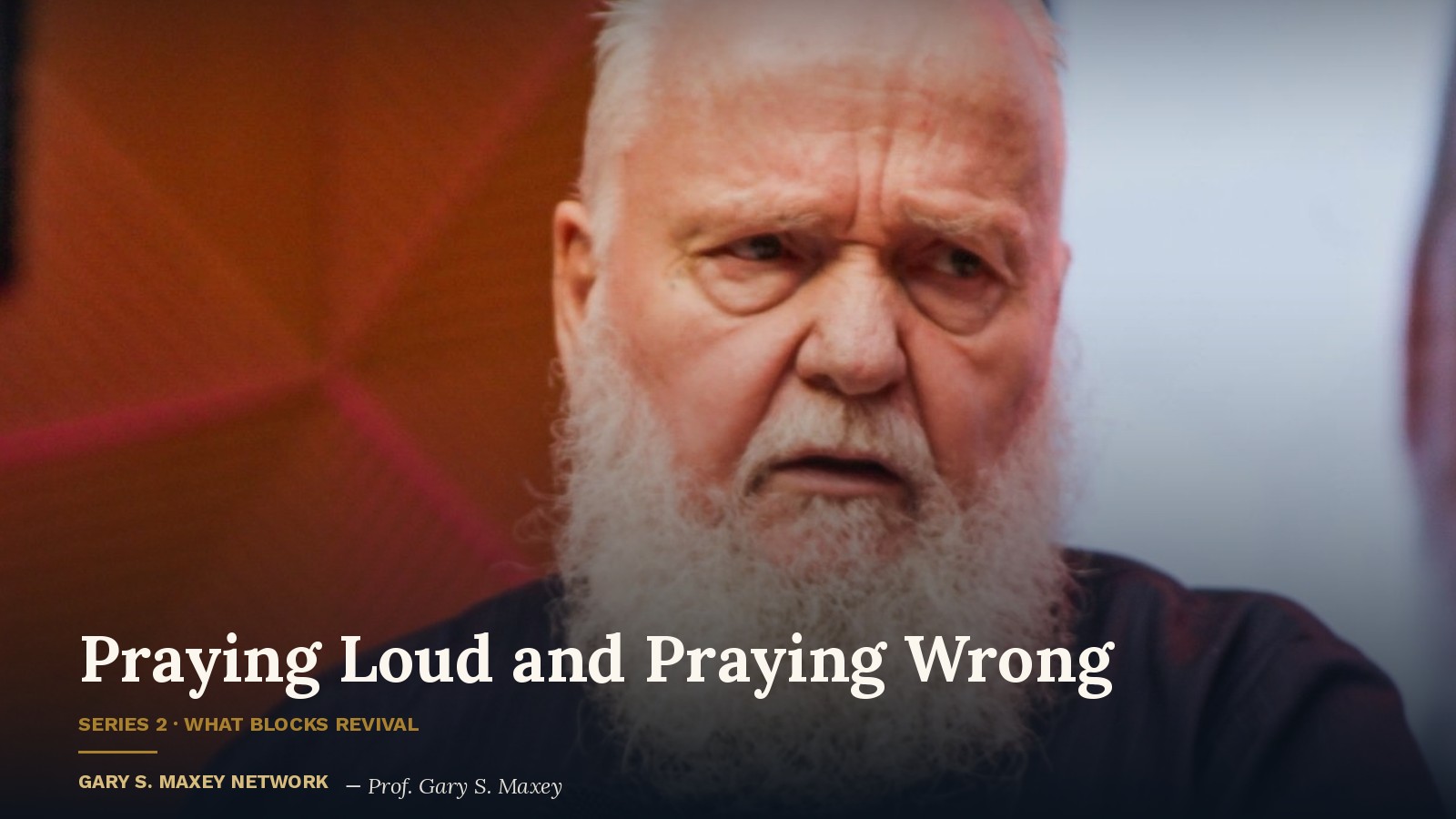
Praying Loud and Praying Wrong
Drawn from the teaching of Professor Gary S. Maxey · 2 min read
Professor Gary Maxey names shallow praying as a major hindrance to revival. He does not mean short prayers, and he does not mean quiet ones. He means prayer without focus.
He describes it as haphazard, shallow, mindless or misdirected. It is full of words and empty of aim. It fills the room with sound and never reaches the heart of God.
The kind of prayer revival needs
In his book on why revival tarries, Professor Maxey says prayer that brings revival moves beyond mere verbiage and noise and cuts through to the heart of God. He ties it to repentance. The prayer he has in mind involves heart-wrenching confession of personal sin and of the sins of the people.
He points to the prophets, who prayed in the first person plural. Isaiah said, "I am a man of unclean lips, and I dwell among a people of unclean lips." Daniel said, "We have sinned and committed iniquity" (Daniel 9:5). They did not pray, "Lord, forgive them." They put themselves inside the problem.
Not "they" but "me"
Professor Maxey insists that a church's problems must not be placed on a distant "he" or "she." They must be placed on "me." He recommends the prayer of the Psalmist: "Search me, O God, and know my heart. Try me and know my anxieties. See if there is any wicked way in me, and lead me in the way everlasting" (Psalm 139:23-24).
That is a dangerous prayer. It asks God to bring up what we have buried.
The wrong target
Many prayer meetings spend their time on enemies, witchcraft, delays and rivals. Professor Maxey's emphasis falls elsewhere. Revival has a prior condition, and the condition sits inside the church.
Corporate, not only private
He adds one more feature. Revival prayer is often shared. In his reading of the book of Joel, the call to revival included a sacred assembly: gather the people, sanctify the congregation, weep between the porch and the altar. He notes that in the 1858 and 1859 revival, especially in America, the movement came largely from lay people moved to meet together and call on God.
Where leadership is slow, ordinary believers are not excused. They can begin.
A practical start
Gather two or three people you trust. Agree on one rule: nobody prays about anybody else. Each person names a sin or a coldness of his own. Then pray for one another, slowly.
If the meeting feels smaller than the loud ones you are used to, ask yourself which one involved more honesty.
Drawn from the teaching of Professor Gary S. Maxey.