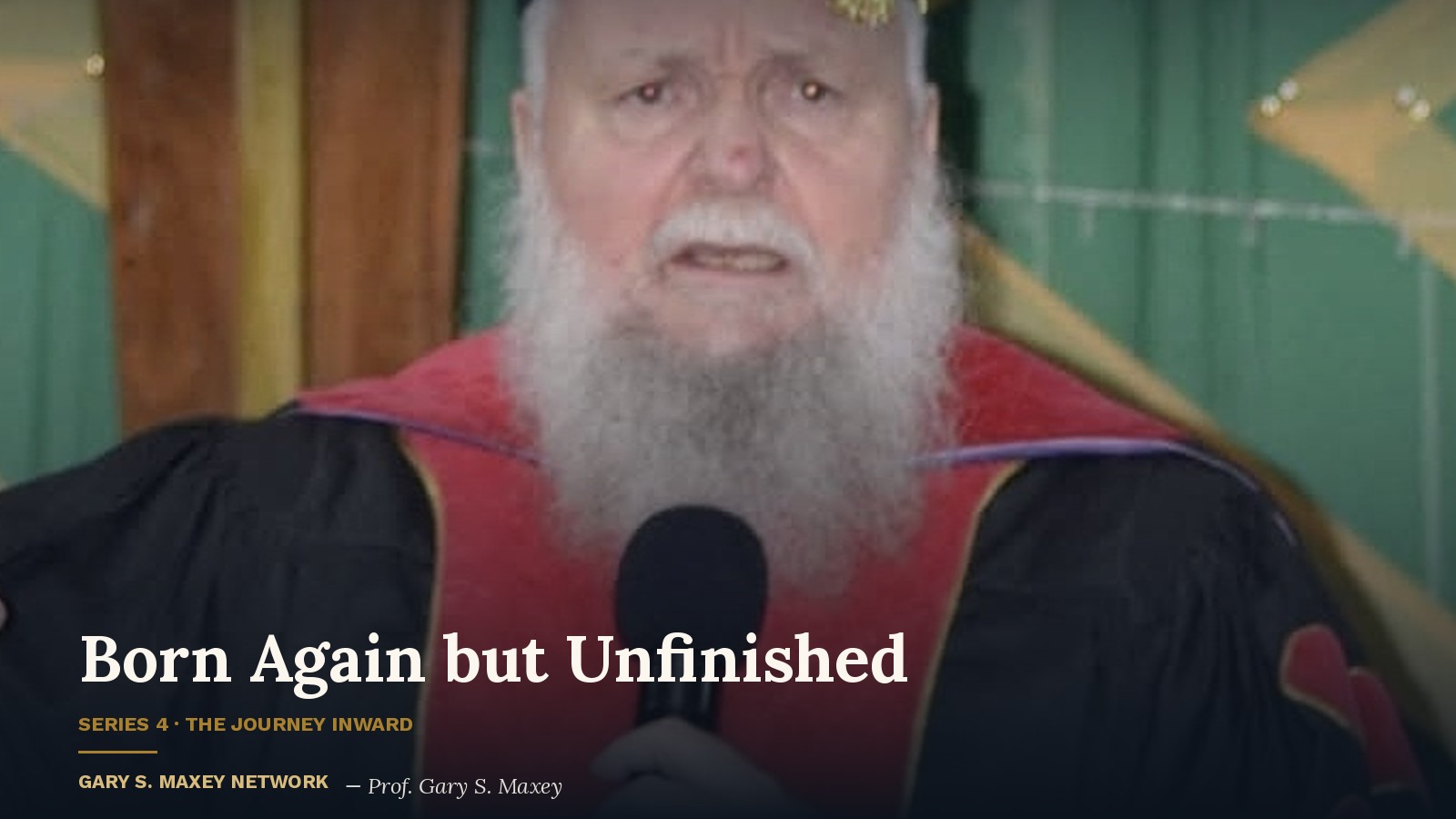
Born Again but Unfinished
Drawn from the teaching of Professor Gary S. Maxey · 2 min read
When Professor Gary Maxey was seventeen, he was born again. He had grown up in a pastor's home and had walked against the light as a religious hypocrite. Then everything changed. In his words, it was like heaven on earth. For the first time since infancy he had a clean conscience. He knew he was forgiven and he feasted on the Word.
He says that is what new birth should be like for any of us.
And then something else appears
Professor Maxey does not stop there. In his book on the Highway of Holiness, he insists that even for born-again believers there is major unfinished business. God is not finished with his work of cleansing. There is more to come.
He gives the reason. Our sins have been forgiven, but an inherited problem remains. In his words, a double-mindedness lives in the heart of every believer. The old ways of sin have been crucified, but the body of sin has not yet been destroyed (Romans 6:6). The new nature lives in the believer and does not rule. The old tendency still lurks.
The four operations
Professor Maxey describes four works of the Holy Spirit in deeper sanctification. The first is illumination. The Spirit shows the believer what is still unclean. The second is separation. The believer is drawn away from every rival allegiance and gives himself more completely to God. The third is purification, in which God cleanses the heart. The fourth is inhabitation, in which the Spirit fills the believer.
He adds a caution. He does not say every believer will experience these in the same order or in the same way. God deals with us as individuals, and ours is not a cookie-cutter faith.
One salvation, not two
Professor Maxey does not teach that this is a different gospel. He describes it as part of the same salvation. Paul wrote that God chose us for salvation through sanctification by the Spirit and belief in the truth (2 Thessalonians 2:13). Initial sanctification happens at new birth. A deeper and progressive sanctification follows.
Spurgeon's complaint
He quotes Charles Spurgeon, who said there are Christians as far above ordinary Christians as ordinary Christians are above the profane. Spurgeon asked why so many of us are content to creep along like worms in the dust.
A question for you
Are you still excited by your conversion, but quietly troubled by something you cannot name? That unrest may be the beginning of God's next work in you. Do not hide from it. Ask him what he is showing you.
Drawn from the teaching of Professor Gary S. Maxey.